夕方6時半、山の上の茶畑に風が渡ります。静岡県舞台芸術公園の野外劇場「有度(うど)」は、400席。客席から見上げると、空がそのまま舞台の背景になります。日が傾くにつれ、光の色が少しずつ変わっていく。
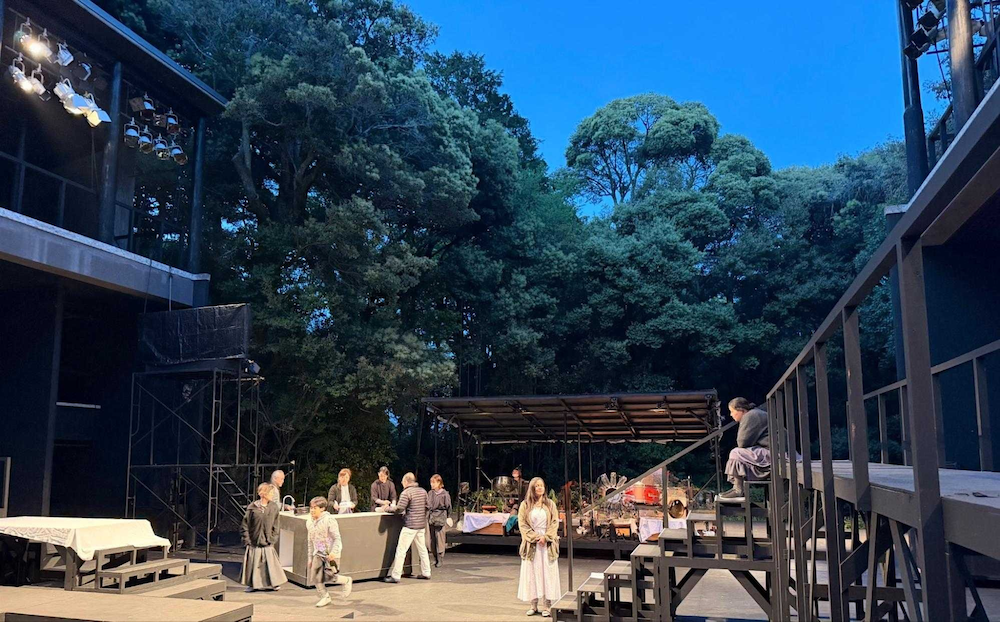
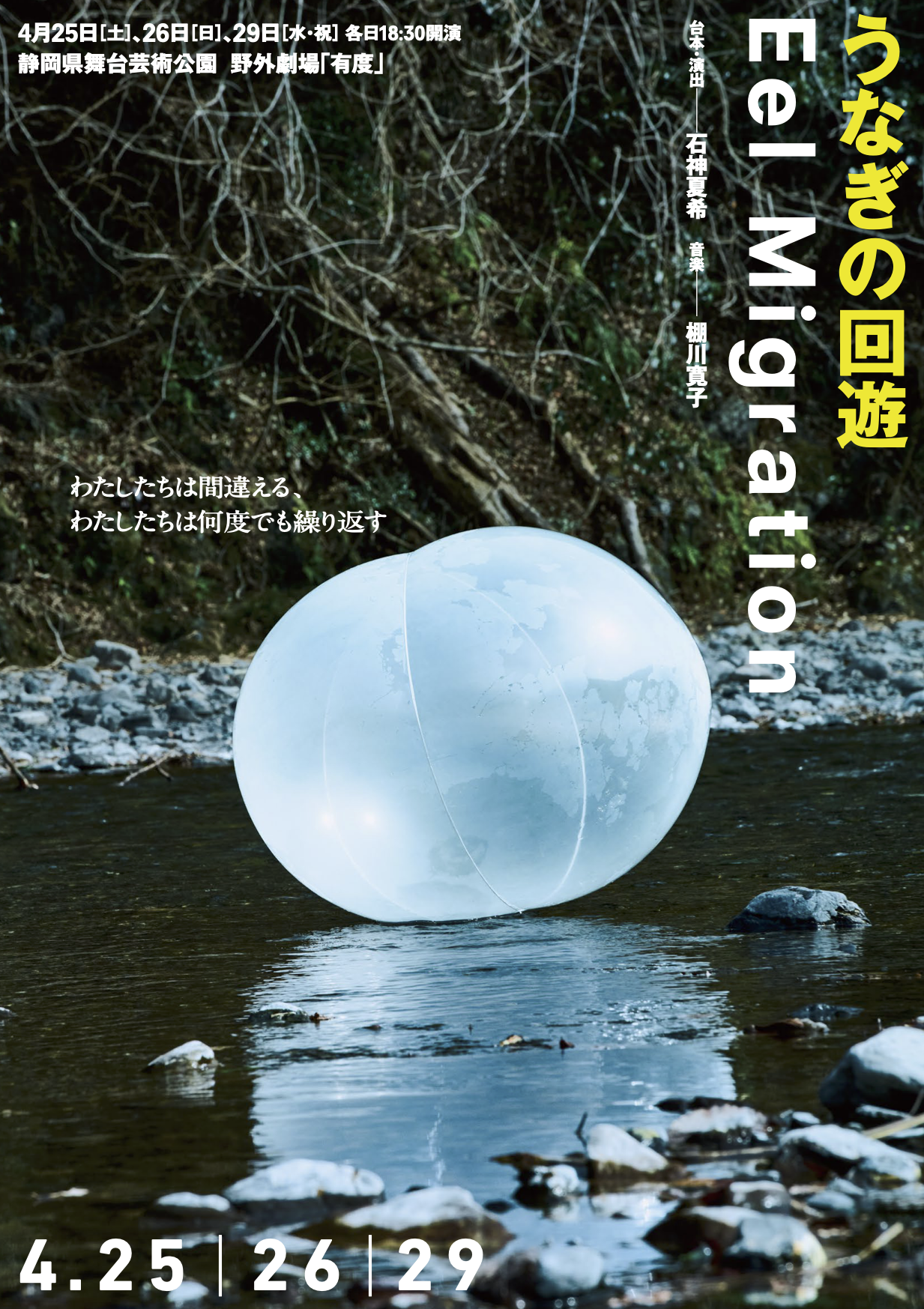
2026年4月25日(土)、26日(日)、29日(水・祝)の3日間、この有度でSPACの新作『うなぎの回遊 Eel Migration』が初演を迎えます。静岡で暮らすブラジルにルーツを持つ県民キャストと、SPACの俳優たちが、2年近くかけて旅してきた作品です。上演は日本語(一部ブラジルポルトガル語)、字幕は日本語・英語・ブラジルポルトガル語の3言語でお届けします。
こんにちは、張藝逸です。東京藝術大学の博士課程で越境する演劇を研究しながら、SPAC(静岡県舞台芸術センター)でインターンをしています。このシリーズでは、本作の創作過程を「人たち」、「音楽」、「うなぎ」、「場所」、「WIP速報」の5回にわたって記録してきました。本番を前にしたこの最終回は、2年近くを共に旅してきたメンバーと、有度という場所でお待ちしている風景をお届けする、招待状のような記事です。
有度という場所
私は昨年12月から、この山の宿舎に泊めてもらっています。初めての山暮らしで、朝は鳥の声で目が覚め、夜は風の気配とともに寝落ちする生活を送っています。窓から桜吹雪を眺めているうちに、集合時間を過ぎてしまう日もあります(すみません!)。いつのまにか日々成長していく茶畑の前には、吉見亮さんが整備してくれた看板が立っていたり、赤松直美さんたちが切った山の竹が束ねて置かれていたりします。稽古中も、鳥や蝶、蜂、蛾がいつもそばにいます。虫は季節ごとに顔ぶれを変えます。
ある日、稽古から戻ってきたメンバーから「親子連れのイノシシに会ったよ〜!」と聞いて、驚きました。「何か対策は取られているんですか」と尋ねると、森山冬子さんはこう言いました。「彼らが先にいて、私たち人間が後から来て邪魔をしている側でしょう」その一言で、視線の向きが、くるりと変わった気がしました。もとからこの山にいるのは彼らで、私たちはあとから建物を建て、バスを走らせ、劇場を開いて、お邪魔している側なのです。(万が一イノシシと鉢合わせしてしまったら、慌てず、大声を出さず、攻撃もしないでください。静かにしていれば、彼らのほうがゆっくり去っていくそうです。)
稽古の始まりは、全員でのラジオ体操。山の空気のなかで大きく深呼吸をし、鳥の声と風の匂いを体に取り込んでから、この場所と呼吸を合わせていきます。
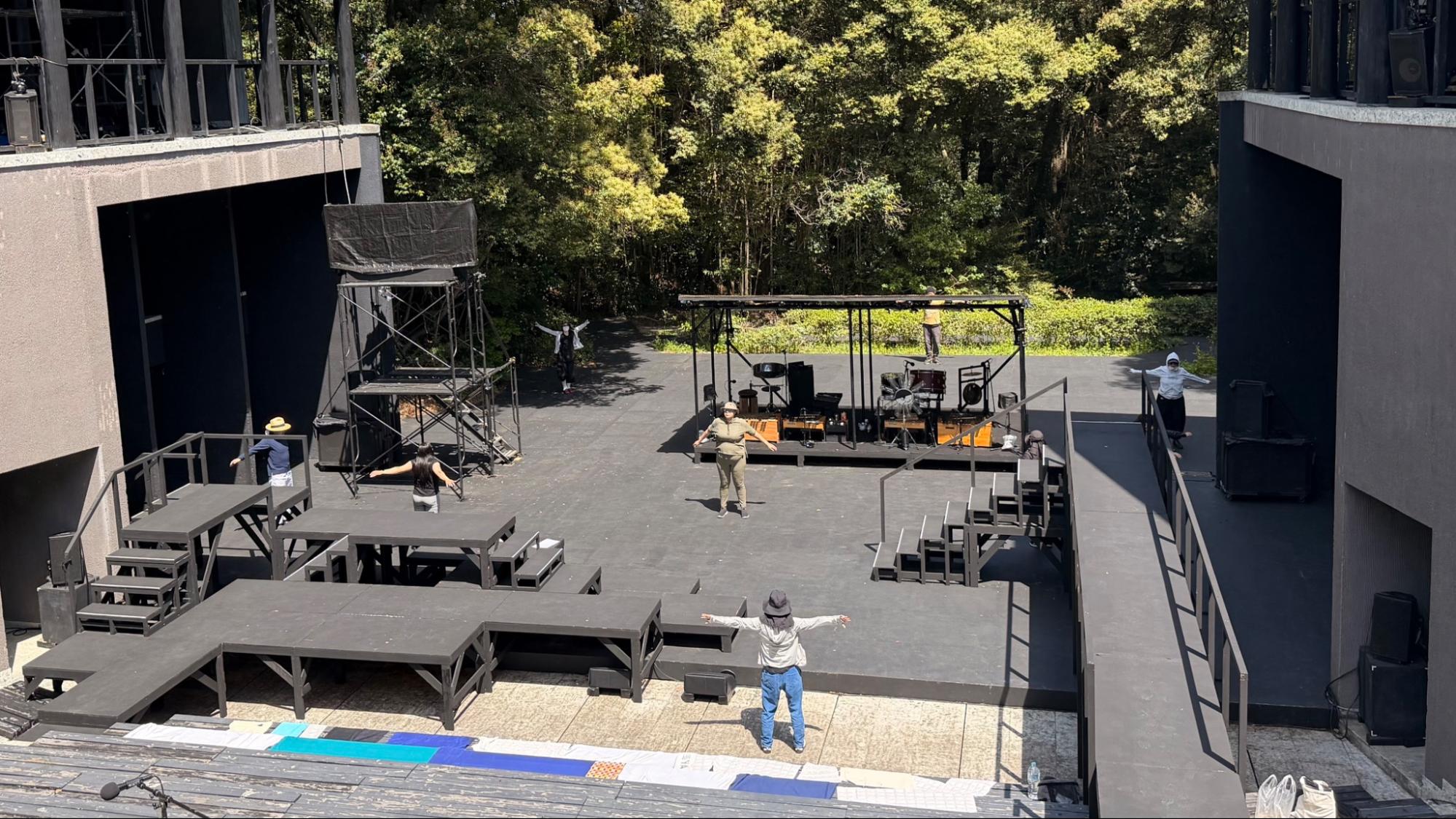
稽古の始まりに、全員でラジオ体操をする様子(撮影:張藝逸)
本番の舞台に響く音もまた、思いがけないところから生まれてきます。音響デザインの和田匡史さんは、「これまで録り溜めてきた波の音が、今回のように活かせたことは、音響家冥利に尽きます」と教えてくれました。SPACの舞台では、音楽は俳優たち自身の手で生演奏されます。作曲の棚川寛子さんは楽譜を使わず、稽古場で一人ずつ音を重ねながら、アンサンブルを組み立てていきます。
「最初は、『えっ?うなぎ!?』って思いました。どんな作品になるのかなと」。タイトルを初めて聞いたときのことを、棚川さんはそう振り返ります。2月のワーク・イン・プログレス公演を経て、その眼差しはいま、一段深いところに届いています。「台本が上がったら、最後までをどう流れを作っていけばいいのかなと。上空から俯瞰して地図を見ている気分で、ダイナミズムを想像していました」。最初の戸惑いから2年近くをかけて、棚川さんは音楽の側から、この作品の地図を描こうとしています。
本番のアンサンブルには、木琴や鉄琴と並んで、空きペットボトルが楽器として加わります。気圧の調整で、異なる音程をつくることができる。普段は捨てられていくはずのものが、手のひらのなかで音を立てはじめる。録音された波、ペットボトル、山の鳥や虫の声。有度で聴こえてくる音は、どこから来るのかわからない、奇妙に混ざり合った響きです。
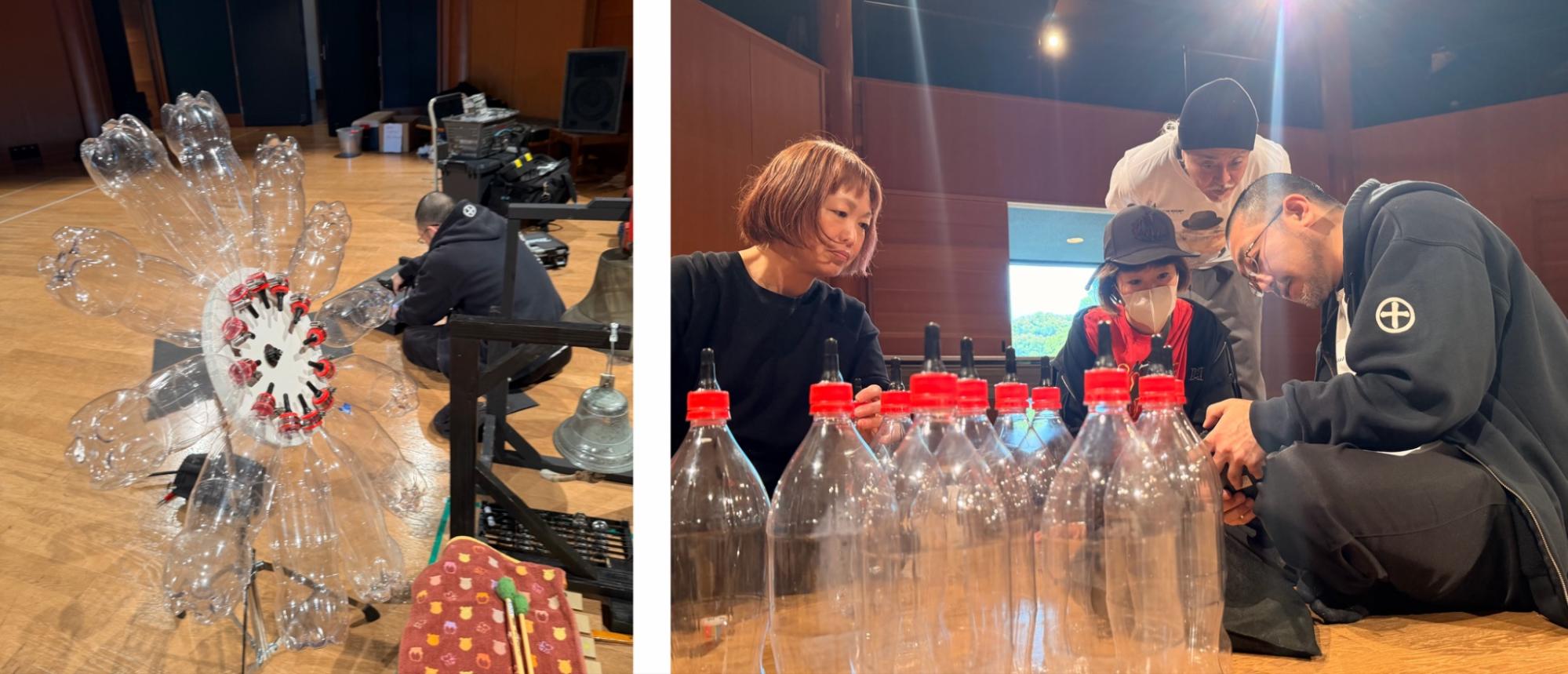
吉見亮さんを中心に、空きペットボトルから楽器を作る稽古場の様子(撮影:張藝逸)
稽古場で起きていることは、人が一人で決めているわけではありません。風、太陽、茶畑、鳥、虫、そして人。ここにいるすべてのいきものが、ひとつの出来事をかたちづくっていく。屋内を出た瞬間から、『うなぎの回遊』はようやく自分のタイトルに追いつこうとしています。そしてこの「視線を変える」という感覚は、じつは作品そのものの核にもなっています。
うなぎの目を借りる
この作品について話していると、よくこう聞かれます。
「うなぎって、移民のことですよね?」
産卵のために数千キロを泳ぐうなぎと、さまざまな事情で海を渡ってきた人々。両者を並べてみれば、たしかに似ているところはあります。けれど、台本・演出の石神夏希さんはこう語っています。
「人生の中で大きな距離を旅する人々と、時間をかけて海から川へ、そして海へと旅する回遊魚のうなぎ。ぴったり重なり合うわけではありません。しかし一度、うなぎの目を通して人間を見てみると、どうして移動をするのか? ふるさととは何か? 自分たちはいったいどこで生まれ、死にたいんだろうか?という普遍的な問いが生まれてきます」(『SPUR』2025年12月24日)
うなぎは、移民の象徴ではありません。うなぎは、視線の高さを変えるための装置です。人間が人間を見るのではなく、うなぎの目を借りて人間を見てみる。といっても、私たちが本当にうなぎになれるわけではありません。けれど、その想像力を借りようとするだけで、国籍、言語、肌の色、日本で過ごした年月といった分け方が、ふと小さく見えてきます。だからこそ、うなぎは舞台に出演しないのだと思います。舞台に立つのは、人間のほうです。
そして、この『うなぎの回遊』の舞台に立つ人間たちの背景には、日本とブラジルを往復してきた、100年以上の物語が流れています。静岡県西部、特に浜松市は、日本最大級のブラジル人コミュニティが暮らす街です。20世紀初頭、多くの日本人が国策のもとブラジルへ渡り、日系人のコミュニティを築きました。そして1990年前後からは、その子孫にあたる多くの日系ブラジル人が、製造業の盛んな浜松を中心に日本へと移り住んできました。日本とブラジルのあいだで、一世紀以上にわたって続いてきた人々の旅。いまこのプロジェクトに集った一人ひとりが、その旅のなかに立っています。
稽古場の人たち、どこかから泳いできた
うなぎの目でこの稽古場を見渡してみると、「移動と存在をめぐる問い」を、すでに日々のなかで生きている人たちが、すぐそばにいる、ということに気づきます。
ブラジルから、浜松から、東京から、鹿児島から、四国から。稽古場に集う人たちは、みな、どこか別の場所から旅をしてきています。大学卒業後に地元を離れ、一人で静岡に移り住み、目の前の仕事に食らいついてきた佐藤飛子さん(制作)もいれば、一つのプロジェクトに全力投球しては旅に出て、会いたい人と会って、また新しい現場に飛び込む暮らしを12年ほど続けてきた降矢一美さん(演出部)もいます。タスマニアで人形劇団とクリエーションをしている最中にオファーのメールを受け取った佐々木文美さん(舞台美術デザイン)や、南米の日系移民をテーマにした作品に参加した経験がある和田匡史さん(音響デザイン)もいます。誰もが『うなぎの回遊』というタイトルを初めて聞いたときに、どこかで自分の来し方と「不思議なご縁」を感じていたようです。
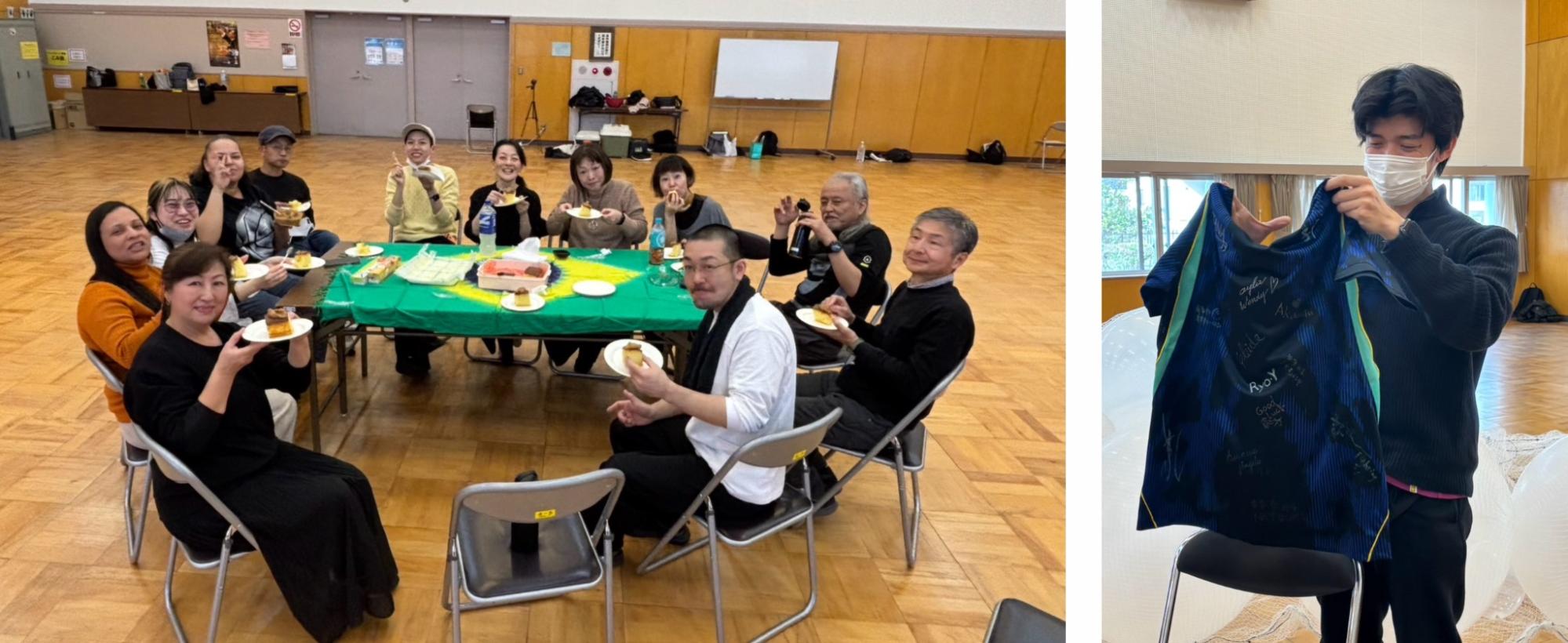
一方で、本番を前に、次の場所へと動いていく人もいます。制作として一年以上この作品に伴走してきた坂中季樹さんは、浜松出身です。「SPACが県西部とのつながりを作る一翼になれたらいいな」という思いを以前から持っていました。浜名湖を代表する特産品であるうなぎと、日本最大級のブラジルコミュニティという静岡県西部の大きな特色の両方を含むこの作品を、多くの方に観てもらいたい、と坂中さんはずっと話していました。その坂中さんが、2025年度末をもってSPACを退職されました。退職を知ってから、出演者のアンジェラさんはキャラメルケーキを焼いて稽古場に持ってきて、みんなで分け合いました。アイラさんが用意してくれた贈り物には、メンバーそれぞれの言葉とサインが寄せられています。来る人、留まる人、去っていく人。稽古場には、つねに誰かの「移動」が流れ込んでいます。
そしてこの問いは、舞台に立つ出演者たちの内側でも、それぞれの形で響いています。
クレイデさんは、ポルトガル語でこんな言葉を送ってくれました。Eu gostaria de transmitir essa ideia de travessia, de que todos nós estamos, de alguma forma, migrando, mudando, nos transformando… mesmo quando não percebemos.(私が伝えたいのは、この「旅」という感覚です。私たちはみな、どこかで、移動し、変わり、姿を変えていっている。自分では気づかないときにさえ。)WIPを経て、ずっと胸のなかにしまっておいた感情が外へ出る道を見つけたようだった、と彼女は書いています。自分の、そして他の人たちの沈黙に、もっと耳を澄ませることを学んだようにも思う、と。
「移動し、変わり、姿を変えていく」という感覚は、プロジェクトのあちこちに、違う形で現れています。この4月から中学1年生になった矢野陽規さんは、WIPの前には「正直、友達を誘えないと思っていた。精子とか卵子とか…オレ思春期だからさ」と話していました。それがWIPを経た今では、本番をみんなに見てほしい気持ちでいっぱいになったそうです。羞恥が、誇りへと反転していく。はるきさんが本番の見どころとして挙げてくれたのは、「みんなが優しくて温かい雰囲気の稽古で、こんなに素敵な作品が出来上がるんだってところ」です。
関連イベント「ブラジル料理を食べながら多文化共生について考えよう」では、アンジェラさんとアイラさんが自分の暮らしの話をしてくれました。アンジェラさんは、住んでいる団地の自治会の班長を3年続けて務めてきました。日本語ができるという理由で、隣人たちに一人ひとり橋をかけ続けてきたと話してくれました。「みんな多分、勇気がないだけ、知らないだけ。やってみれば変わる」。アイラさんは、「昔は戦っていたけれど、疲れてしまった」と語りました。「自分は誰なのかを本当に知っていれば、人から何を言われても傷つかないはず。それをいま、子どもたちと一緒に作っているところです」。舞台の外でも、この人たちは日々、『うなぎの回遊』の問いを生きています。
SPACの俳優たちもまた、この作品に関わるなかで、少しずつ景色が変わってきているようです。吉見亮さんは、最初は「うなぎ=美味しいけれど高価な食べ物」という認識しかなかったそうですが、いまでは、うなぎに関するニュースや研究記事にも自然と目が向くようになり、「『うなぎ』について考えることで、生命そのものをとらえ直す、そんな作品になると思う」と語ります。貴島豪さんもまた、「四つの季節を経ていよいよ本番が近づく中、改めてこのプロジェクトでクリエーションができている喜びを感じています。未だ謎の多いうなぎの『生』、人と人とのつながり、営み、そして自分の現在地…風が触れる屋外劇場でそういったことなどに思いを馳せて頂ければ幸いです」と、観客に語りかけています。
うなぎの目で見ると、この稽古場は、移動と存在をめぐる問いを、それぞれの人生のかたちで、すでに生きている人たちの集まりなのでした。誰がどこから来たのか、誰がどこへ行くのか。そうした線は、見ていると、静かに引けなくなっていきます。
「せかい」は、あなたの隣に
石神さんが『SHIZUOKAせかい演劇祭2026』のキャッチコピーに掲げたのは、「『せかい』はあなたの隣に住んでいる。」でした。あらゆる距離が消失しつつある現在、「せかい」は、手のひらの上でいつでも見られるのに触れられない他者と、すぐそばで暮らしているのに見えない他者になったのだと、石神さんはアーティスティック・ディレクターのメッセージのなかで書いています。
うなぎの目を借りるということは、その隣にいる見えない「せかい」を、見えるようにすることでもあります。人間だけが動いているのではないと知ること。劇場の建つこの場所が、もとは誰のものだったのかを思い出すこと。移民/日本人という線引きをいったん外して、全員が同じ海域を泳いでいる風景を見ること。そして、劇場の椅子に座った自分の隣に、どんな「せかい」が座っているかに気づくこと。それが、うなぎの目を借りるということなのかもしれません。
制作の佐藤飛子さんは、お客様のエネルギーと重なって「その刹那に生まれる『完成』」を楽しみにしていると言います。そして森山冬子さんは、観に来てくださる方へ向けてこう語りかけています。
「このお話は、自分のお話かもしれないし、ほかの誰かのお話かもしれない」
バスに揺られ、坂を登り、茶畑の風を受けながら、有度までたどり着く。その道のりも、すでに作品の一部です。うなぎと、先にいた住人たちと、風と、太陽と、2年かけて泳いできた仲間たちと、そしてあなたが、ひとつの時空にそろって初めて、この作品は完成します。
有度で、お待ちしています。
※日が沈むと山の上は一気に冷え込みます。暖かい服装でのご来場を強くおすすめします。
最後になりますが、この素晴らしい取り組みに深く関わらせていただいていること、そしてシリーズの執筆にご協力いただいた皆さまに、心から感謝を申し上げます。一つの記事では書き切れなかった出来事や、名前を挙げきれなかった人たちが、本当にたくさんいます。そのすべてが、4月の有度の舞台に、もう乗っています。これからの旅を、楽しみにしています。
〈公演情報〉
SHIZUOKAせかい演劇祭2026
『うなぎの回遊 Eel Migration』
日時:2026年4月25日(土)、26日(日)、29日(水・祝)各日18:30開演
会場:舞台芸術公園 野外劇場「有度」
上演時間:90分(予定)
上演言語/字幕:日本語上演(一部ブラジルポルトガル語)/日本語・英語・ブラジルポルトガル語字幕
〈関連企画〉
■フェスティバルcafe&bar ― Festa Brazil(ブラジル・ナイト)
日時:2026年4月25日(土)、26日(日)15:00~22:00、4月29日(水・祝)12:00~22:00
会場:舞台芸術公園 せかいの劇場ミニミュージアム「てあとろん」
詳細は『うなぎの回遊 Eel Migration』公演詳細ページをご覧ください。
6:30PM. Wind moves across the tea fields on the mountain. Udo, the 400-seat outdoor theater at Shizuoka Performing Arts Park, sits on the northern slope of Nihondaira Hill. Look up from your seat and the sky itself becomes the backdrop. As the sun sinks lower, the color of the light shifts, minute by minute.
On three days in April 2026, Saturday the 25th, Sunday the 26th, and Wednesday the 29th, SPAC will give the world premiere of its new work, “Eel Migration“, here at Udo. It’s a piece that SPAC actors and community performers of Brazilian roots living in Shizuoka Prefecture have been traveling with for nearly two years. The performance is in Japanese, with some Brazilian Portuguese, and comes with subtitles in three languages: Japanese, English, and Brazilian Portuguese.
Hello. I’m Yiyi Zhang, a doctoral student at Tokyo University of the Arts researching transcultural theater, and I’ve been interning at SPAC (Shizuoka Performing Arts Center). Across this series, I’ve documented the creative process in five installments: People, Music, Eels, Place, and WIP Report. With the premiere just ahead, this final piece is something like a letter of invitation: a portrait of the companions I’ve been traveling with for almost two years, and of the place at Udo where we’ll be waiting for you.
The Place Called Udo
I’ve been staying at the artists’ residence on this mountain since last December. It’s my first time living in the mountains. I wake to birdsong and drift off to the sound of wind. One time I watched cherry blossoms scatter past my window and lose track of time, missing the rehearsal call. (Sorry about that.) In front of the tea fields, which seem to grow a little more every day, there’s a signboard that Ryo Yoshimi put up, and stacks of mountain bamboo that Naomi Akamatsu and others have cut and bundled. Every time I notice one of these small gestures, something inside me warms.
Birds, butterflies, bees, and moths stay close during rehearsal. The insects change with the seasons. And wild boars live on this mountain too. One day a member came back from rehearsal and said, “I ran into a mother boar with her babies!” When I asked whether there was some kind of countermeasure in place, Fuyuko Moriyama answered quietly: “They were here first. We humans came later. We’re the ones getting in the way.” With that one sentence, my perspective rotated. The boars had been here from the beginning. We came later, built our buildings, ran our buses, and opened our theater. We are the ones intruding. (If you happen to meet a boar, don’t panic, don’t shout, don’t threaten it. Stay quiet, and it will slowly move on.)
Every rehearsal begins with radio calisthenics, a group exercise routine that has been broadcast nationally in Japan since before World War II. We take deep breaths in the mountain air, letting the birdsong and the scent of wind into our bodies, tuning ourselves to this place before we begin.
Deep breathing during radio calisthenics. Photo by Yiyi Zhang
The sounds that will rise up on the actual stage also come from unexpected places. Sound designer Masashi Wada told me, “Being able to put the wave recordings I’ve been collecting for years to use like this — for a sound designer, it’s the greatest reward.” At SPAC, the music is performed live by the actors themselves. Composer Hiroko Tanakawa works without a written score; in the rehearsal room, she builds the ensemble by layering sounds in, one player at a time.
“At first I was like, huh? Eels?! I had no idea what kind of piece it would turn into.” That’s how Tanakawa recalls hearing the title for the first time. After February’s work-in-progress performance, her gaze has reached somewhere a step deeper. “Once the script was in, I kept thinking about how to shape the flow all the way through to the end. It felt like looking down at a map from above, imagining the dynamics of the whole thing.” From that first moment of bewilderment, across nearly two years, Tanakawa has been charting this piece from within its music.
In the ensemble for the premiere, empty plastic bottles take their place alongside xylophones and metallophones. By adjusting the air pressure inside them, you can produce different pitches. Things usually thrown away begin to speak in the palm of a hand. Recorded waves, plastic bottles, the voices of the mountain’s birds and insects. The sounds at Udo are strange, mingled reverberations, and it’s hard to tell where any of them are coming from..
Making instruments from empty plastic bottles, led by Yoshimi. Photo by Yiyi Zhang
What happens in this rehearsal space isn’t decided by any single person. Wind, sun, tea fields, birds, insects, humans. Everyone present here shapes a single event together. The moment we step outdoors, Eel Migration begins to catch up with its own title. And this sensation of shifting one’s perspective turns out to be the very core of the work itself.
Borrowing the Eel’s Eyes
When I talk about this piece, I often get asked:
“So the eels stand for migrants, right?”
Eels that swim thousands of kilometers to spawn, and people who have crossed seas for various reasons. Side by side, yes, there are resemblances. But the writer and director, Natsuki Ishigami, puts it this way:
“People who travel great distances over the course of a lifetime, and eels, migratory fish that journey over time from ocean to river and back to ocean again. The two don’t overlap perfectly. And yet, once you try looking at human beings through the eyes of an eel, universal questions begin to surface. Why do we move? What is home? Where, in the end, do we want to be born, and to die?”(SPUR, December 24, 2025)
The eel is not a symbol of the migrant. The eel is a device for shifting the height of our gaze. Instead of humans looking at humans, we borrow the eyes of an eel and look at humans through them. Of course, we can’t really become eels. And yet, just by borrowing that act of imagination, the usual dividing lines (nationality, language, skin color, years spent in Japan) begin to look smaller. This, I think, is why eels never appear on stage. What appears on stage is human beings.
Western Shizuoka, and the city of Hamamatsu in particular, is home to one of Japan’s largest Brazilian communities. In the early 20th century, many Japanese emigrated to Brazil under government policy and built substantial Japanese-descendant communities there. From around 1990, many of their descendants, Japanese Brazilians, began moving back to Japan, often settling in manufacturing hubs like Hamamatsu. For more than a century, people have been traveling back and forth between Japan and Brazil. Each person gathered in this project stands, in one way or another, inside that long journey.
The People in This Rehearsal Room All Swam Here From Somewhere
When you look around this rehearsal room through eel eyes, you notice something: people who are already living, day by day, with the questions of movement and existence are right there beside you.
From Brazil, from Hamamatsu, from Tokyo, from Kagoshima, from Shikoku. Everyone who gathers in this rehearsal room has traveled in from somewhere else. Hiko Sato (producer) left her hometown after graduating from university, moved alone to Shizuoka, and has thrown herself into the work in front of her ever since. Kazumi Furuya (staging) has lived for about twelve years by one rhythm: pour everything into a project, then head off to travel, meet the people she wants to see, and throw herself into the next site. Ayami Sasaki (set designer) received the email offering her this project while she was in Tasmania, in the middle of a creation with a local puppet theater company. Masashi Wada (sound designer) had previously worked on a piece about Japanese emigration to South America. When each of them first heard the title “Eel Migration,” they seem to have felt some strange thread of connection with their own past.
Meanwhile, as we approach the premiere, some are moving on to the next place. Toshiki Sakanaka, who has accompanied this work as producer for over a year, is originally from Hamamatsu. “I’d long hoped SPAC could play a part in building ties with western Shizuoka,” he has said. This work brings together the eel, the signature specialty of Lake Hamana, and one of Japan’s largest Brazilian communities, the two defining features of western Shizuoka. Throughout the process, he kept saying he wanted many people to see it. At the end of fiscal year 2025, Sakanaka left SPAC. When the news spread, Angela baked a caramel cake and brought it to the rehearsal room, and everyone shared it. Ayla prepared a farewell gift inscribed with words and signatures from each of us. Being present as someone leaves is itself one shape of the question of movement and existence.
And this question echoes, too, inside each of the performers on stage, each in their own way.
Cleide Pereira Haseyama, sent the following words in Portuguese: Eu gostaria de transmitir essa ideia de travessia, de que todos nós estamos, de alguma forma, migrando, mudando, nos transformando… mesmo quando não percebemos. (“What I want to convey is this sense of travessia — that all of us are, in some way, migrating, changing, transforming… even when we don’t realize it.”) After the WIP, she writes, it felt as though feelings she had long kept inside finally found a way out. She also feels that she has learned to listen more closely to silences — her own, and those of others.
The feeling of “migrating, changing, transforming” surfaces in different forms throughout this project. Haruki Yano, who started seventh grade this April, said before the WIP, “Honestly, I didn’t think I could invite my friends. Sperm, eggs… I’m in puberty, y’know.” But after the WIP, he says, he is now full of wanting everyone to come see the real show. Shame, flipping over into pride. What Haruki pointed to as the heart of the show is “the fact that such a beautiful piece comes out of rehearsals where everyone is kind and the atmosphere is warm.”
At a related event called “Thinking About Multicultural Coexistence Over Brazilian Food,” Angela and Ayla spoke about their daily lives. Angela has served three years in a row as the block leader of her apartment complex’s residents’ association. Because she was the one who spoke Japanese, she told us, she ended up introducing each neighbor to the next, one person at a time, building a bridge between them. “I think most people just lack the courage, or they just don’t know yet. If you try, things change.” Ayla said, “I used to fight. But I got tired.” She went on: “If you really know who you are, then no matter what people say, you shouldn’t be hurt. That’s what I’m building right now, together with my children.” Outside the theater too, these people are living the questions of “Eel Migration” every day.
SPAC’s actors, too, have found their own view of things shifting as they’ve worked on this piece. Ryo Yoshimi says that at first, “eel” meant nothing more to him than “delicious but expensive food.” Now, he finds his eye naturally drawn to news stories and research articles about eels. “I think this will be a piece where, through thinking about eels, you come to grasp life itself anew.” Tsuyoshi Kijima adds: “Having passed through four seasons with this project, with the premiere finally close, I feel a renewed joy at being able to create within it. The still-mysterious ‘life’ of the eel, the connections between people, our daily living, and where each of us stands right now — I hope that, in this open-air theater where the wind touches you, the audience will let their thoughts drift to things like these.”
Seen through an eel’s eyes, this rehearsal room is a gathering of people who, each in the shape of their own life, are already living the questions of movement and existence. Who came from where, who is going where. The longer you look, the harder it becomes to draw those lines.
“Sekai,” the World, Is Sitting Right Next to You
The tagline Ishigami has chosen for SHIZUOKA Sekai Theatre Festival 2026 is: “Sekai,” the world, lives right next door to you. In an age when every distance is disappearing, she writes in her message as Artistic Director, “the world” has become two things at once. It is the untouchable other we can see any time on the palm of our hand, and the invisible other who is already living right beside us.
Borrowing the eel’s eyes means making that invisible neighboring “world” visible. It means knowing that humans are not the only ones in motion. It means remembering whose land this was before a theater stood on it. It means setting aside, for a moment, the line between “migrant” and “Japanese,” and looking at the scene in which everyone is swimming the same waters. And it means noticing what kind of “world” is seated right next to you in the audience.
Producer Hiko Sato is looking forward to the “completion” that will be born in the moment when the audience’s energy merges with the company’s own. And Fuyuko Moriyama has this message for those who will come to see the show:
“This story might be your story. Or it might be someone else’s.”
Swaying in the bus, climbing the hill, catching the wind off the tea fields, finally arriving at Udo. The journey itself is already part of the work. Only when the eels, the ones who were here first, the wind, the sun, the companions who have been swimming together for two years, and you, all arrive in the same time and place, will this piece truly be complete.
We’ll be waiting for you at Udo.
A note: once the sun sets, the mountain grows cold very quickly. Please dress warmly.
Finally, I would like to express my heartfelt gratitude for being so deeply involved in this remarkable project, and to everyone who has supported me in writing this series. There are so many things one article could not hold — so many names I could not fit in. All of them are already there, on the stage at Udo this April. I am looking forward to the journey ahead.
Performance Information
World Premiere|Shizuoka World Theater Festival 2026
“Eel Migration”
Script and Direction: Natsuki Ishigami (SPAC)
Dates: Saturday, April 25, and Sunday, April 26, Wednesday, April 29, 2026, each at 6:30 PM
Venue: Open Air Theatre “UDO”, Shizuoka Performing Arts Park
Running time: Approx. 90 minutes
Languages: Japanese and partial Brazilian Portuguese with Japanese, English and Brazilian Portuguese surtitles.
Tickets and further information: please visit the SPAC official website.
*Related Event
Festival cafe & bar ― Festa Brazil
Dates & Times:
April 25 (Sat) & 26 (Sun), 2026, 3:00 PM–10:00 PM
April 29 (Wed), 2026, 12:00 PM–10:00 PM
Venue: The Mini Museum of World Theatre in Shizuoka “THEATRON”
Shizuoka World Theater Festival 2026 Official Site


